


If you typed this question into your search engine this morning after glancing at your pending emails and a list of tasks that all seemed more urgent than the last, we have the solution for you.
In this article, we're offering our tips on how to be more productive at work, work faster, and finally say bye-bye to stress and procrastination: whether you're a freelancer or an employee, the Horus X team explains how to boost your productivity!
⚠️ This article focuses on your personal organization. We have an article on productivity tools coming very soon to round all this off!
What is being productive?

To gain in productivity, you first need to grasp an important concept: your efficiency isn't necessarily linked to time spent working! In other words, just because you stay behind your screen all day long doesn't mean you're going to plow through the mountain of tasks on your to-do list and be truly productive.
Let’s look at the definition of productivity according to INSEE:
“In economics, productivity is defined as the ratio, in volume, between production and the resources used to obtain it.”
As you can see, time is not a concept that factors into the notion of productivity, even if managing your time is of great importance in becoming more productive (but we’ll talk about that below).
Therefore, being productive means being efficient at work: being able to accomplish set tasks and objectives and meet deadlines by utilizing the resources and tools at your disposal.
Tip number 1: set clear and achievable goals to increase productivity
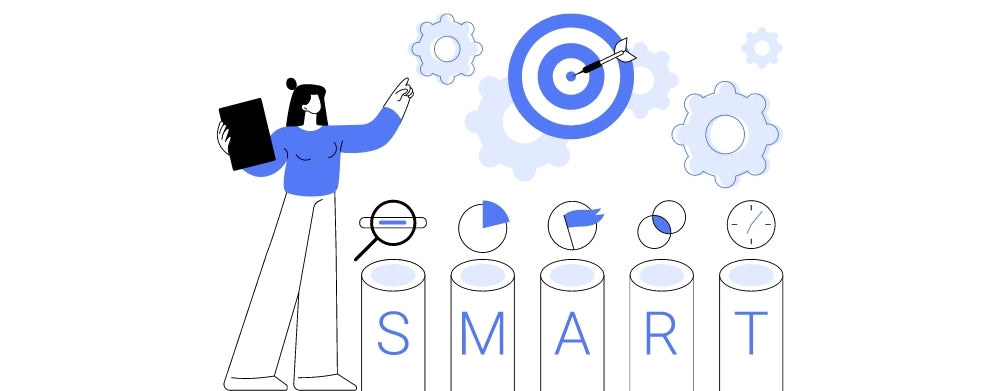
To be efficient, you must start by taking stock of your goals. The basic rule is to define clear, achievable, and realistic objectives using the SMART method.
It involves defining your goals based on 5 criteria:
- 🔍 S for Specific: define your objective precisely
- 📏 M for Measurable: essential for evaluating progress and the achievement of your goal
- ✅ A for Achievable: your goal must be attainable and acceptable
- 🙌 R for Realistic: don’t set the bar too high
- ⏱️ T for Time-bound: by giving yourself a deadline, you will be able to better evaluate the time management required for this task or the set of tasks to reach your goal
By doing this, you'll already be able to sort things out and find more coherence in what you do and why you do it.
Tip number 2: List important tasks and set priorities
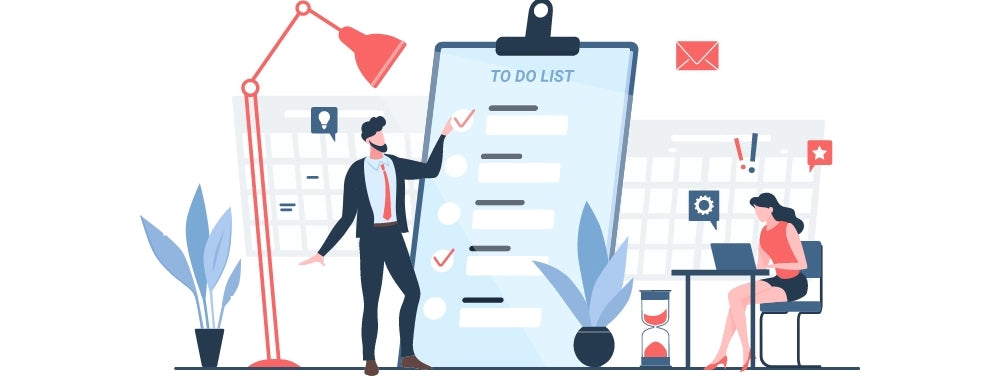
Once your goals are clearly defined, we advise you to list all the work tasks to be accomplished to see things more clearly: you will inevitably notice that there are tasks more important than others, and those that you can delegate, postpone, or even abandon.
Double bonus of the to-do list: clearing your mind!
By noting down clearly everything you have to do, you can better visualize the scale of the work but also sort through it. Because yes, you cannot do everything and every box on your to-do list cannot be checked off in a single day.
If you want to gain efficiency, a trick that can make the difference is to draw up a clear list of things to do the evening before for the next day, based on the amount of work you have left at the end of the day.
Once this first task list is clear, it's time to move on to sorting and prioritizing: evaluate the importance of each action and its connection to your goal. Which task is a priority and which ones are less so? Which one requires teamwork and which ones can wait?
By ranking your to-dos, you have a better chance of completing your tasks faster and wasting less time: make the work easier for yourself by establishing a clear action plan without getting scattered.
Tip number 3: Adopt a tailored organization for a more productive day
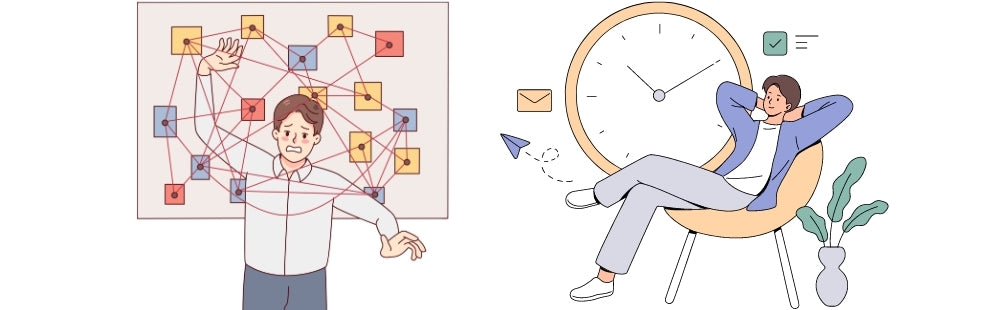
As you will have guessed, one of the keys to optimizing your productivity is to get organized.
Once your goals are clearly defined and tasks prioritized, you now need to adopt a finely-tuned organization that will allow you to gain efficiency at work but also enjoy moments of relaxation during the rest of the day.
Our little organizational tips for a productive day:
- 📝 Prepare an action plan: we mentioned it just above; the to-do list is truly the foundation. At the end of the day, take 5 minutes to note and prioritize what you want to do the next day to move forward on current projects. You can also make a "done list," which allows you to see what has already been accomplished and cross it off—that is super satisfying.
- ✋ Avoid multitasking: try instead to focus on one task at a time, moving from one task to another by starting with the most important one. You will be less distracted and will visualize your progress more clearly. Most of the time, multitasking is a trap; don't fall into it.
- ✂️ Break your work down into clearly identifiable micro-tasks: essential when you are on a big project, but it applies to everything! List the steps necessary to reach the goal, the required resources, potential tasks to delegate, as well as those you can automate, and take each micro-task one by one to make progress.
- ⌚️ Set up work blocks with a defined time for a given task: depending on the scale of the work, plan a 30, 60, or even 90-minute session entirely dedicated to a specific goal. You can plan your workday with a paper planner or dedicated tools. Some methods are even based on using a timer, such as the Pomodoro technique, which consists of organizing your work time into 25-minute sessions followed by 5 minutes of rest to stay focused for short periods.
- 🐸 Eat the frog every morning: OK, this one must have at least made you smile, but know that we didn't invent it. It comes from Brian Tracy, who uses Mark Twain's frog metaphor: "Eat a live frog first thing in the morning and nothing worse will happen to you the rest of the day." Basically, if you get rid of the most painful task early in the day, you avoid procrastinating and feel lighter. However, we advise against the amphibian for breakfast; it's a bit heavy to digest.
- 📦 Try batching: what if you grouped all similar tasks to perform them all at once? That’s the principle of batching. This way, you eliminate time-consuming little tasks, like managing emails for an hour each morning, for example.
- ⏸️ Take regular breaks: contrary to what one might think, taking breaks is essential to gain productivity. It allows you to recharge your batteries and is indispensable for your well-being at work!
💡 Good to know: your ideal workday might not look like your neighbor's: some are more efficient in 3 hours of work while others need a whole day; some are morning people and others are not. Finally, you may have noticed that some organizational methods didn't necessarily suit you. We remind you that the tips we give here are suggestions to be tested and adapted according to your preferences.
Tip number 4: Boost your concentration and avoid distractions
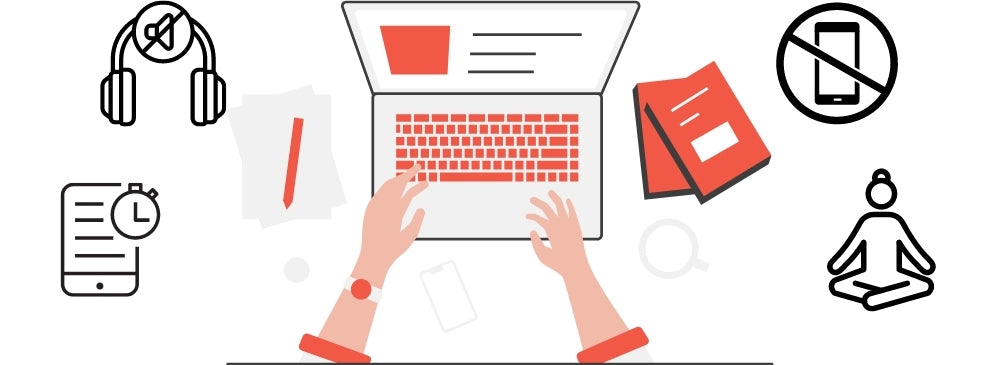
It’s no mystery: to boost productivity at work as elsewhere, you must eliminate distractions!
If you want to follow your schedule and to-do list properly, we recommend establishing deep work sessions to complete each step linked to your goals.
And here you ask us, what is deep work?
This productivity method promoted by Cal Newport can be translated as "travail profond" in French:
“Deep Work is the ability to focus without distraction on a cognitively demanding task. It is a skill that allows you to master complicated information and produce better results in less time.”
Basically, during a deep work session, you remain focused on a given task by eliminating distractions.
It is generally a method recommended for projects that require a lot of involvement, time, and attention, but it can also allow you to get more work done in less time.
As with the Pomodoro technique, we advise you to alternate between work sessions and breaks: the right ratio is 45 minutes of concentration (maximum 90) for at least 5 minutes of break.
But how do you avoid distractions? Good question! You’ve probably noticed that our days are punctuated by a multitude of stimuli, and we often find it hard to stay focused on a single activity.
Our advice for cutting off disruptive elements when you want to stay productive: wear noise-canceling headphones with a playlist specially designed for working, turn off notifications on your phone, or put it in another room altogether to avoid the temptation to check it.
There are even applications that limit screen time to help you stay focused.
You can also boost your concentration by practicing daily relaxation: if you want to know how, we recommend reading our complete guide on meditation to improve concentration!
Tip number 5: Optimize your workspace for more comfort

And yes, comfort at work is a real value-add for your productivity!
Do not neglect the importance of a good posture at the office and an ergonomic workspace: this will allow you, on one hand, to limit the onset of pain and other MSDs (Musculoskeletal Disorders), but also to put yourself in good conditions and therefore be more efficient.
Our recommendations for an ergonomic workstation:
- 🖥️ An adapted desk: the height of your screen should be aligned with your eyes to respect the head-neck-trunk axis. The must-have is a good sit-stand desk to avoid a static position!
- 🪑 A comfortable chair: just like for a good gaming setup, your chair is very important; we advise you to choose it with care.
- 🖱️ An ergonomic mouse: after long hours on a computer, you might start feeling wrist pain if you haven't opted for the right mouse.
- 🤓 Remember to filter harmful blue light: if you spend a lot of time in front of screens, remember to use glasses to filter artificial blue light, which is responsible, among other things, for eye strain and serious complications in the long run. We explain everything here. For work, we offer elegant glasses with the best filtration on the market: our Nomade collection. Heavy screen users can also turn to our Gaming collection.
💡 Good to know: the brightness intensity of your screen also matters! For more comfort, choose the ideal screen brightness for your eyes, in addition to quality blue light blocking glasses.
Tip number 6: Preserve your sleep to be high-performing during the day

The last tip we can give you to boost your performance at work is to sleep well and have a healthy lifestyle.
It might sound obvious, but have you ever tried to work on a big project after an all-nighter or an upset stomach? If so, you surely see what we mean: quality restorative sleep is your best ally to be fresh and ready at the office, while a healthy lifestyle keeps you in shape for all your activities.
If you want to know more about the subject, we suggest taking a look at our complete guide: how to get deep and restorative sleep with a few simple tips!
Final word: how to be more productive at work
- Contrary to what you might think, productivity at work is more linked to your efficiency than to the time spent behind your screen: being productive means managing to complete your tasks and reach your goals with the resources at your disposal
- The first step to boosting your productivity is to take stock of your goals: they must be clear, achievable, and feasible within a known timeframe. Without that, you're navigating by sight, and that's already off to a bad start for gaining efficiency
- Your organization plays a fundamental role: draw up clear task lists, prioritize them, break them down, and divide your day into blocks of time interspersed with breaks to reach your daily goals
- To be productive, you must also be capable of focusing: in the age of hyper-connectivity, many of us have an increasingly hard time staying focused on a given task. Get rid of distractions and set up time slots strictly dedicated to work according to your personal rhythm.
- Do not neglect the importance of the comfort of your workstation as well as your quality of life: good sleep and a healthy lifestyle will allow you to boost your productivity as well as your well-being (and that is also very important!)